


Sugar Rush at 1xBet
1xBet carries Sugar Rush in its games lobby — the Pragmatic Play candy slot that trades traditional paylines for a wide 7×7 grid and a cluster-pay system. What sets this game apart isn’t the sweets on the reels but the positions where they explode: every tile on the grid keeps its own memory, stacking multipliers each time a win lands repeatedly in that exact spot. This guide breaks the mechanic down in full, then does the part most reviews skip — turning the RTP and volatility figures into real Rand numbers, tying those numbers to a realistic bankroll, and being upfront about where the published statistics come from.
Sugar Rush Key Specifications
| Feature | Detail |
|---|---|
| Provider | Pragmatic Play |
| Game type | Video slot, cluster-pay system |
| Theme | Sweets and candy |
| Grid | 7 x 7 |
| Payout system | Cluster Pays — 5 or more connected matching symbols |
| RTP | 96.5% (operator-selectable down to 95.5% or 94.5%) |
| Volatility | Very high (5/5) |
| Hit frequency | 34.5% — a win of some size lands roughly every 2.9 spins |
| Free spins trigger frequency | Roughly once every 323 spins on average |
| 1,000x+ win frequency | Roughly once every 37,900 spins on average |
| Maximum win | x5,000 the stake |
| Odds of hitting the maximum win | Around 1 in 2.34 million spins |
| Tumble feature | Yes — continuous symbol drops after each win |
| Position-based multipliers | Yes — start at x2 and double up to x128 |
| Wild symbol | None |
| Scatter symbol | Yes — triggers the free spins round |
| Free spins | 10 to 30 spins depending on the number of scatters |
| Direct feature buy | Yes — at a cost of x100 the stake |
| Mobile compatibility | Yes, HTML5 |
Sugar Rush Gameplay
On the data source: the hit frequency, bonus frequency, and max-win odds above come from Pragmatic Play’s published game statistics, repeated consistently across independent slot-information sites. They’re theoretical, long-run figures calculated from the game’s math model — not a guarantee for any individual session. Third-party real-money tracking tools, which log actual player spins rather than the underlying math model, sometimes show different short-term numbers for RTP and bonus frequency on any given slot; that’s expected statistical variance around the same theoretical model, not a sign the published figures are wrong.
The complete absence of a wild symbol is worth noting compared with most similar slots, since Sugar Rush builds its entire payout structure around accumulating position-based multipliers as the main compensating mechanic instead.
Visual Design and How It Affects Play
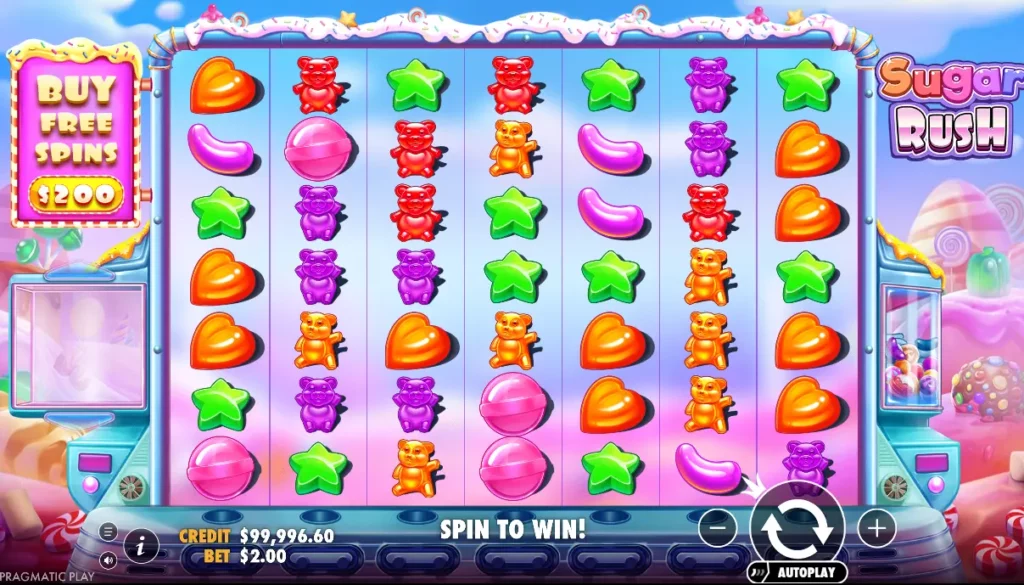
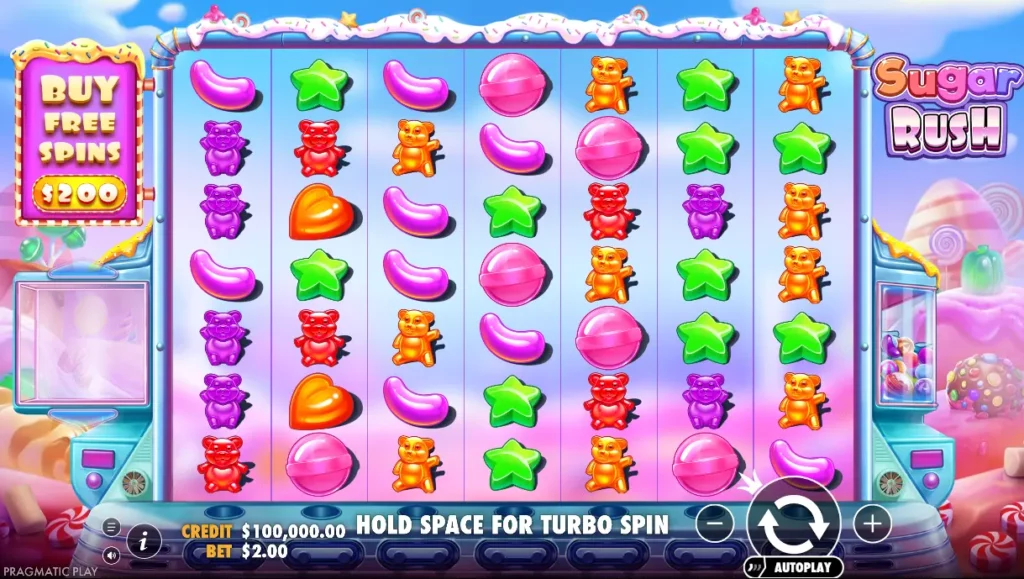
The 7×7 grid sits inside a candy-machine frame, filled with gummy bears in three colours, a green star, a pink jelly bean, an orange heart, and a pink lollipop head at the top of the paytable. Beyond aesthetics, the design has one practical effect worth flagging: with 49 grid positions constantly clearing, dropping, and re-filling during a tumble chain, tracking which specific tiles are carrying a multiplier gets genuinely difficult to follow by eye once a chain runs long, particularly during free spins when several positions can be marked at once. The interface doesn’t currently highlight marked positions with a distinct visual marker beyond the small on-tile number, so players relying on visually following the multiplier build-up should expect to lose track during longer chains — the math keeps working correctly regardless, but the visual read of “how big is this about to get” is less reliable than the underlying mechanic.
The Cascading Tumble Mechanic
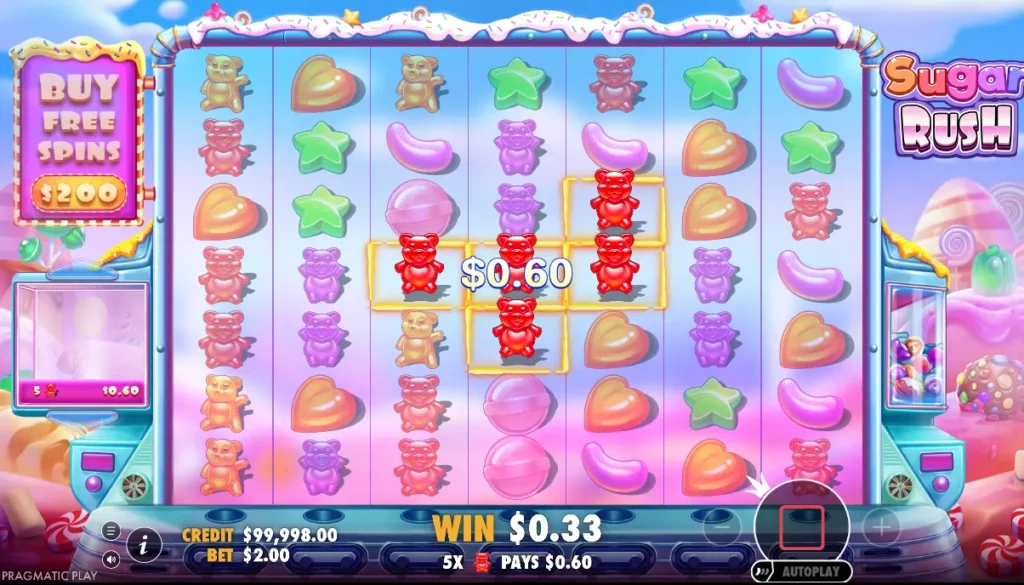
Wins form through clusters rather than lines: a player needs at least 5 identical symbols connected horizontally or vertically to form a win. When that happens, the winning symbols clear from the grid, and new symbols drop in from above to fill the gaps. If the new symbols form another winning cluster, the process repeats automatically without waiting for a new spin, and the chain continues until no winning cluster remains on the grid.
The Position-Based Multiplier System: The Real Heart of the Game
This is the feature that sets Sugar Rush apart from most other slots running the Tumble mechanic. When a winning symbol explodes from a specific position on the grid, a visible mark stays in that exact spot. If another winning symbol later explodes in that same position — whether in the next tumble or a later spin — a multiplier is added, starting at x2.
Doubling mechanic. Every time a winning symbol explodes on a position that already carries a multiplier, its value doubles: from x2 to x4, then x8, and so on up to the maximum cap of x128.
Applying multipliers to wins. Any winning symbol that lands on a position holding a multiplier benefits directly from that value. If a single win includes several positions with different multipliers, all values are added together before being applied to the total win for that cluster.
Base game vs. free spins. In the base game, marked positions and their multipliers are wiped clean at the end of each full tumble sequence, so every new spin starts from zero. During free spins, marked positions and their multipliers stay on the grid for the entire round, letting them climb across multiple consecutive spins without being cleared. This is exactly why the biggest wins concentrate almost entirely within the bonus round — a claim the math backs up, as shown further down.
Sugar Rush Interface
Triggering the Free Spins Round and Extending It
Landing 3 or more scatter symbols anywhere on the grid during a tumble sequence activates the free spins round, with the number of spins awarded depending on how many scatters landed:
- 3 symbols → 10 spins
- 4 symbols → 12 spins
- 5 symbols → 15 spins
- 6 symbols → 20 spins
- 7 symbols → 30 spins
The same table applies to retriggering during an active free spins round — landing between 3 and 7 new scatter symbols on any spin within the round adds the corresponding number of extra spins, with no fixed limit on how many times this can extend. On average, based on Pragmatic Play’s published trigger data, a scatter trigger lands naturally around once every 323 spins — which matters directly for the bankroll planning below.
Buying the Free Spins Round Directly
For anyone who doesn’t want to wait for the bonus to trigger naturally, the game allows paying the equivalent of x100 the current stake for immediate entry into the free spins round, with a random landing of between 3 and 7 scatter symbols. This means the number of spins awarded through the purchase is also random, not fixed at the minimum — it can deliver either the smallest or largest available spin count, and the price is identical either way. Pragmatic Play confirms the RTP is unchanged whether the round is triggered naturally or bought, so the purchase is best understood as paying to remove variance in when the bonus arrives, not as a way to improve the underlying odds.
Symbol Payout Table
Values below are multipliers of the total stake, based on the size of the winning cluster (from a minimum of 5 symbols up to 15 or more):
| Symbol | 5 symbols | 15+ symbols |
|---|---|---|
| Orange gummy bear | x0.2 | x20 |
| Purple gummy bear | x0.25 | x25 |
| Red gummy bear | x0.3 | x30 |
| Green star | x0.4 | x40 |
| Pink jelly bean | x0.5 | x60 |
| Orange heart | x0.75 | x100 |
| Pink lollipop head | x1 | x150 |
The gap between the gummy bears and the higher-value symbols is fairly wide — a common Pragmatic Play design choice that gives the game’s own thematic elements more visual and financial weight.
The Real Math: House Edge and Why It Varies by Operator
RTP of 96.5% means the house edge is 3.5% — for every R100 wagered over a very large number of spins, the game is designed to return R96.50 and keep R3.50. Sugar Rush is built with three certified RTP configurations (96.5%, 95.5%, 94.5%), and it’s the operator — not the player, and not chance — that selects which configuration runs on their platform, usually as a licensing or commercial choice on the casino’s side. That’s why the same game can carry a materially different house edge from one site to another: at 95.5% the edge rises to 4.5%, and at 94.5% it rises to 5.5%, which is a meaningfully worse long-run outcome for the same amount of play. Checking the RTP figure in the in-game paytable before playing is the only way to know which version is actually live.
Expected loss per spin scales directly with bet size:
| Bet size | Expected loss per spin (at 96.5% RTP) |
|---|---|
| R3 | R0.11 |
| R10 | R0.35 |
| R50 | R1.75 |
| R200 | R7.00 |
| R1,800 | R63.00 |
This is a theoretical average, not a guarantee — with very high volatility, individual sessions swing far above or below this line in both directions.
Bankroll Planning by Bet Level
Using the expected loss figures above, here’s roughly what a 100-spin and 500-spin session costs in theory at different stakes:
| Bet size | Expected cost per 100 spins | Expected cost per 500 spins |
|---|---|---|
| R3 (minimum) | R10.50 | R52.50 |
| R10 | R35.00 | R175.00 |
| R50 | R175.00 | R875.00 |
| R200 | R700.00 | R3,500.00 |
| R1,800 (maximum) | R6,300.00 | R31,500.00 |
Connecting this to an actual bankroll figure. Since the free spins round only arrives naturally once every 323 spins on average, a bankroll should realistically cover more than one shot at reaching it. A practical rule that follows directly from the table above: budget at least 3–5x the “cost per 500 spins” figure for your chosen stake before sitting down, which gives you a reasonable chance of surviving through one or two natural bonus attempts even if the first one or two runs come up dry. At R50 a spin, for example, that works out to roughly R2,600–R4,400 set aside as a session bankroll, not just the R875 theoretical cost of a single 500-spin run.
Honest Session Expectations
Pragmatic Play publishes the trigger frequency (1 bonus round per 323 spins) as part of its official game statistics, but doesn’t publish a full outcome-probability distribution for sessions of a given length — the figures below are derived from that confirmed trigger rate and should be read as a calculated estimate, not an official session-outcome guarantee.
Using that trigger rate, the probability of a session going through without hitting a single natural free spins round works out to roughly:
- 100-spin session: around 73% chance of zero bonus rounds
- 323-spin session (the statistical average): around 37% chance of zero bonus rounds
- 500-spin session: around 21% chance of zero bonus rounds
Because the position-based multipliers only accumulate freely inside free spins, this matters more in Sugar Rush than in most slots: a session that never reaches the bonus round is, realistically, a session that plays out close to (or below) the base-game payout table, without the multiplier stacking that produces the game’s bigger wins. The flip side is that a session which does reach the bonus round — especially one that retriggers — can outperform the theoretical RTP by a wide margin. This is the honest shape of a Sugar Rush session: a high chance of a fairly flat, break-even-or-down outcome, against a lower but real chance of a result well above average, concentrated almost entirely in the bonus round.
A Strategic Approach to Playing
The game runs on certified random generation, so there’s no technique that controls when an explosion will repeat in the same position or how many scatter symbols will land. What follows is organisational, built directly on the numbers above rather than general advice:
Size the bankroll to the bonus frequency, not to a target win. Use the 3–5x rule from the bankroll section above as a starting point, and adjust down only if you’re comfortable with a real chance of not reaching a natural bonus round at all.
Weigh the bonus buy on its own terms. At x100 the stake, buying the round costs the same regardless of whether it lands the minimum 3 scatters (10 spins) or the maximum 7 (30 spins). Since the RTP is identical whether the round is bought or earned naturally, treat the purchase as a way to control when you reach the feature, not as a shortcut to better odds.
Confirm the RTP version before committing a bankroll to it. Because the operator — not the player — selects between 96.5%, 95.5%, and 94.5%, checking the paytable first can change your effective house edge by up to 2 full percentage points before a single spin is placed.
Use fixed spin-block checkpoints, not a fixed loss limit. Checking in every 100 spins against the expected-cost table (rather than stopping only when a loss limit is hit) makes it easier to judge whether a run without a bonus round is ordinary variance — which, per the odds above, happens in roughly a fifth to three-quarters of sessions depending on length — or a genuine bad stretch worth walking away from.
Sugar Rush Win
Sugar Rush Compared to Similar Candy Slots
Sugar Rush vs Sweet Bonanza. Both come from Pragmatic Play and share the candy theme and Tumble mechanic, but the underlying maths differ in ways that matter for bankroll planning. Sweet Bonanza pays random multipliers (up to x100) that land directly on tumbling symbols with no positional memory, carries a higher win ceiling at x21,175, and a standard RTP of 96.51% with a free spins trigger frequency of roughly 1 in 400 spins. Sugar Rush relies on position tracking with accumulating multipliers up to x128, a lower ceiling of x5,000, but a noticeably more frequent natural bonus trigger at roughly 1 in 323 spins. In practical terms: Sweet Bonanza offers a longer shot at a bigger single win with a longer average wait for the bonus; Sugar Rush trades some of that ceiling for a bonus round that arrives, on average, about 20% more often.
Sugar Rush vs Big Bass Bonanza. The difference here is structural rather than just mathematical. Big Bass Bonanza uses a classic 5×3 grid with 10 fixed paylines and a fisherman symbol that collects fish values during free spins, running at a standard 96.71% RTP with a considerably lower volatility rating than Sugar Rush’s 5/5. That lower volatility means smaller, more frequent wins in exchange for a much lower max win ceiling of x2,100 compared with Sugar Rush’s x5,000. Anyone prioritising steadier, more predictable sessions will find Big Bass Bonanza the easier fit; anyone comfortable with the deeper dry spells shown in the session-probability table above, in exchange for a higher ceiling, will lean toward Sugar Rush.
1xBet Bonuses for Sugar Rush Players
1xBet offers a welcome package spread across four deposits for anyone opening a new account, which can be used toward Sugar Rush along with the rest of the casino library. The first deposit adds a 100% match up to R6,000 plus 30 free spins on Reliquary of Ra, the second brings a 50% match up to R7,000 plus 35 free spins on the same title, the third adds a 25% match up to R8,000 plus 40 free spins on Juicy Fruits 27 Ways, and the fourth deposit rounds off the package with another 25% match up to R9,000 plus 45 free spins on Rich of the Mermaid Hold and Spin. Worth being clear about: this is a general casino welcome package rather than a Sugar Rush-exclusive offer, and none of the included free spins run on this specific title. The bonus comes with wagering conditions that need to be completed within a set time window, along with a capped maximum stake while clearing it, so reviewing the full terms before opting in is worthwhile — particularly since high-volatility, high-stake spins like Sugar Rush’s maximum bet can bump against wagering stake caps.
Registration and Getting Started
Registration on 1xBet takes just a few minutes via email, a phone number with an SMS verification code, or direct authorisation through a social media account. Once the account is set up, it’s worth completing identity verification early to avoid any delays when requesting a withdrawal later on. After that, finding Sugar Rush is straightforward — head to the casino section and search under Pragmatic Play slots.
Playing Sugar Rush on Mobile
The wide 7×7 grid is optimised through HTML5 technology to run smoothly on smaller screens, keeping the colourful design clear despite the density of moving elements on the grid. The Android app or iOS app can also be installed for quicker access without going through the browser every time, with balance and spin history syncing automatically across devices. One practical note carried over from the design section above: tracking multiplier positions by eye across a long tumble chain is harder on a smaller screen than on desktop, so players who want to follow the multiplier build-up closely may prefer the larger display of a tablet or desktop browser session over a phone screen.
 Thabo Mthembu