


Aviator at 1xBet
1xBet carries Aviator in its games lobby — the crash game from Spribe that turned a single rising number into one of the most recognisable formats in online gaming. There are no reels, no symbols, no paylines — just a small plane climbing across the screen and one decision that defines every round: when to cash out before it disappears. This guide covers the mechanics in full, then does what most Aviator reviews skip entirely — the actual probability math behind the multiplier, translated into concrete odds and Rand figures.
Aviator Key Specifications
| Feature | Detail |
|---|---|
| Provider | Spribe |
| Release year | 2019 |
| Game type | Crash game |
| RTP | 97% (house edge 3%) |
| Starting multiplier | x1.00 |
| Maximum multiplier | Operator-configurable; commonly set at x10,000 or higher on most platforms |
| Dual betting | Yes — two independent betting panels |
| Auto cash out | Yes, with a configurable target multiplier |
| Auto bet | Yes |
| Fairness system | Provably Fair, based on cryptographic seed values (SHA-256/SHA-512) |
| Live chat | Yes |
| Minimum bet | Around R2 |
| Mobile compatibility | Yes, HTML5, no download required |
The 97% RTP is Spribe’s standard published figure for Aviator, and it’s a fixed input to the game’s crash-point formula rather than an estimate — a distinction that matters more here than in most casino games, and one the next section explains in full. Some operators can run Aviator at a different RTP configuration, so the exact figure and the maximum multiplier cap are worth checking in the rules panel inside the game itself before setting a stake.
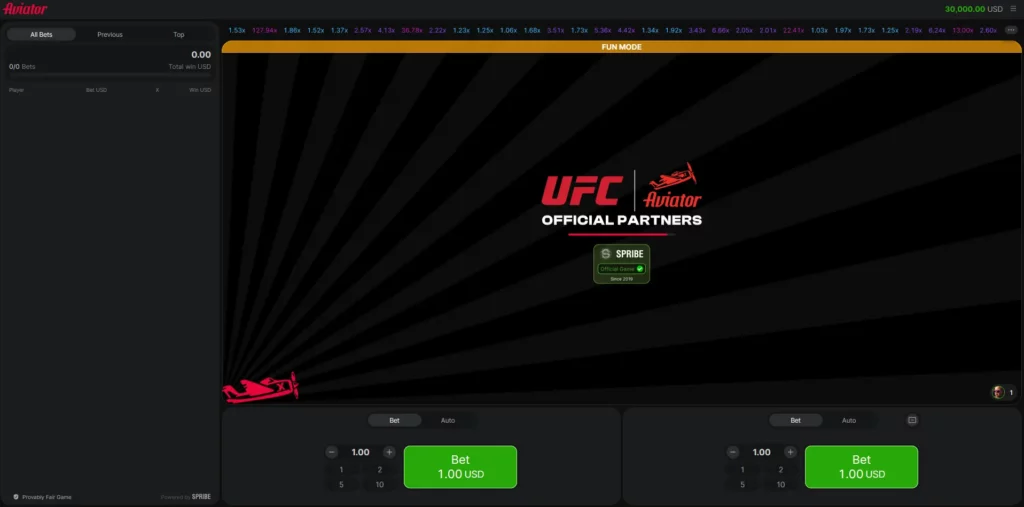
Aviator Interface
The Math Behind Every Round
Aviator doesn’t pick a crash point from a random table — it calculates one from a cryptographic hash, and that calculation produces what’s called a geometric distribution: low multipliers are common, high multipliers are exponentially rarer, and the whole curve is anchored to the 3% house edge. The practical version of that formula is:
Probability of reaching multiplier m or higher ≈ 0.97 ÷ m
That single relationship explains almost everything about how the game behaves in practice:
| Target multiplier | Approximate probability of reaching it |
|---|---|
| x1.50 | ~64.7% |
| x2.00 | ~48.5% |
| x3.00 | ~32.3% |
| x5.00 | ~19.4% |
| x10.00 | ~9.7% |
| x20.00 | ~4.85% |
| x50.00 | ~1.94% |
| x100.00 | ~0.97% |
The house edge also shows up directly at the bottom end: roughly 3% of all rounds crash at exactly x1.00, before the multiplier moves at all — that 3% is where the casino’s edge is actually realised, baked into the formula itself rather than collected some other way.
The core takeaway from this table is one most players intuitively get wrong: every single target multiplier carries the exact same expected value, roughly -3% of the stake, regardless of whether the target is x1.50 or x50.00. A lower cash-out target doesn’t offer “better odds” in any mathematical sense — it only changes how often you win and how large each win is, not the long-run result.
What This Means in Rand
Since the expected value is a constant -3% of stake regardless of target multiplier, the expected loss per round scales the same way at every cash-out setting:
| Bet size | Expected loss per round (at 97% RTP) |
|---|---|
| R2 | R0.06 |
| R10 | R0.30 |
| R50 | R1.50 |
| R200 | R6.00 |
| R1,000 | R30.00 |
Over a full session, that theoretical cost adds up predictably regardless of which cash-out target is chosen:
| Bet size | Expected cost per 100 rounds | Expected cost per 500 rounds |
|---|---|---|
| R2 (minimum) | R6.00 | R30.00 |
| R10 | R30.00 | R150.00 |
| R50 | R150.00 | R750.00 |
| R200 | R600.00 | R3,000.00 |
| R1,000 | R3,000.00 | R15,000.00 |
Turning this into a bankroll figure. Because a crash game is played in continuous rounds rather than waiting for a rare bonus feature, a practical bankroll for a fixed session length is simpler to size than in a slot: budgeting roughly 2–3x the “expected cost per 500 rounds” figure for your stake gives enough room to absorb a losing streak at your chosen cash-out target without exhausting the bankroll on ordinary variance. At R50 a round, that means treating R750 as the theoretical cost of the session but setting aside closer to R1,500–R2,250 before starting.
How the Core Mechanic Works
The concept is direct, but the tension it creates is genuine. Before each round, there’s a short window to place a bet. Once the round starts, the plane takes off and the multiplier begins climbing from x1.00. The longer the plane stays in the air, the higher the multiplier rises — but at any point, without warning, it can disappear.
Cashing out in time means the bet is multiplied by whatever value is showing on screen at the exact moment of the click, and the win is added to the balance instantly. Missing the window means the bet is lost entirely, with no partial payout of any kind. There’s no way to predict the exact moment the plane will crash — each round’s crash point is fixed by the cryptographic hash before the round even starts, which the Provably Fair section below covers in detail.
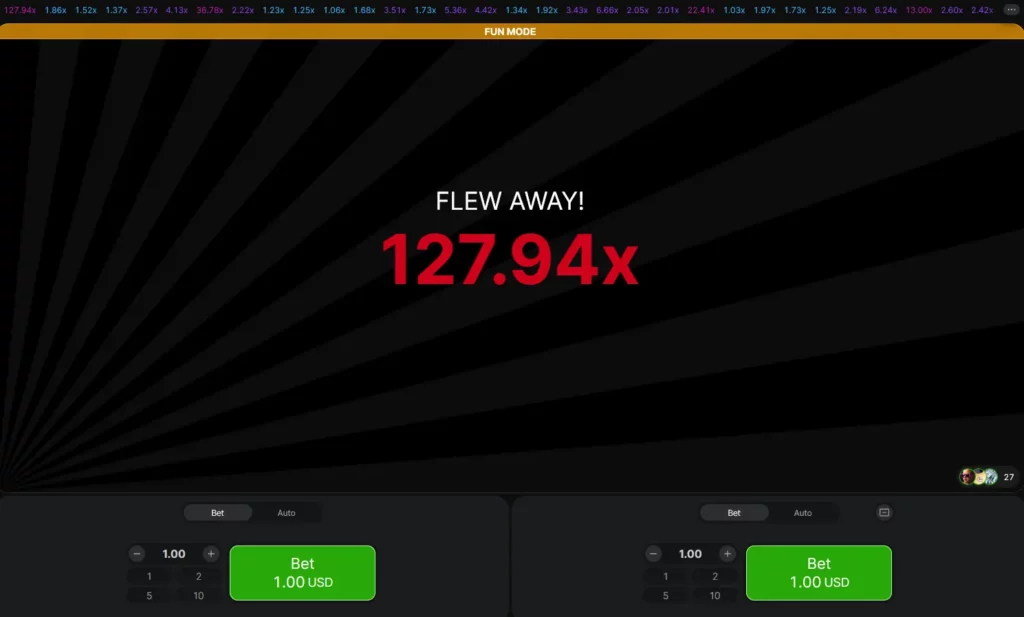
Aviator End Game
The Dual Betting System
One of the features that sets Aviator apart from more basic crash games is the ability to run two independent bets in the same round, each with its own stake and its own cash-out decision.
Splitting between safety and risk. Using the probability table above, a conservative panel set to auto cash-out at x1.50 wins roughly 65% of rounds, while a second panel managed manually toward x5.00 or higher wins only around 19% of the time but pays proportionally more. Running both together doesn’t change the combined expected value — it’s still -3% per rand staked across the two panels — but it does change the shape of the outcome, smoothing out the frequent small wins from the first panel against the occasional larger win from the second.
Complete independence. Cashing out one bet has no effect whatsoever on the other — each betting panel runs as its own separate stake within the same round.
Auto Cash Out and Auto Bet
For anyone who’d rather not make the manual call every round, the game offers two automation tools that can be combined:
Auto Cash Out — lets you set a target multiplier before the round begins. The moment the counter reaches that value, the system cashes out automatically without any further action. The probability table above applies directly here: setting an auto cash-out target is, mathematically, choosing a point on that table, not choosing a better or worse deal.
Auto Bet — places the same stake automatically on every new round, without needing to confirm manually each time.
Combining both tools allows for a fully automated session at whatever risk level is chosen, which is particularly useful for anyone who prefers a consistent approach without reacting to each round in real time — though it’s worth noting that automation doesn’t reduce the house edge; it only removes the manual decision-making from each round.
The Provably Fair System
Every Aviator round is generated through a fairness system built on cryptographic seed values combined between the server and the client — a server seed, plus client seeds contributed by the first three players to bet in a round, hashed together and converted into that round’s crash multiplier using the formula behind the probability table above. Because the crash point is fixed by this hash before the round starts, the outcome can be independently verified after the fact by re-running the same hash calculation, confirming that no result was altered after the event. This level of transparency goes beyond the standard found in most traditional slots, where only the overall RTP is certified across large samples rather than allowing verification of each individual round.
Live Chat and Real-Time Statistics
Aviator includes a panel showing the live bets of other players in the current round, along with a history of recent multipliers and the biggest wins recorded over different time periods. Worth using this table for what it actually is: a record of past independent rounds, not a signal for what’s coming next. Because each round’s crash point is generated fresh from that round’s own seed values, no pattern in the recent-multiplier history changes the probability of the next round — the geometric distribution in the table above holds regardless of what just happened. A live chat connecting all active players adds a social layer that’s uncommon in this type of game, where playing in complete isolation is usually the norm.
Bet Limits in South African Rand
The minimum bet in Aviator sits at around R2 per round, while the maximum bet and the maximum multiplier cap both depend on the specific configuration set by the operator. Per the probability table above, multipliers above x100 already occur in fewer than 1% of rounds, and the frequency keeps falling exponentially from there — so an operator’s specific ceiling (whether that’s x10,000 or higher) mostly matters for the small fraction of rounds that go unusually far, not for typical session outcomes. It’s always worth checking the exact limits in the rules panel inside the game before setting a stake.
A Strategic Approach to Playing Aviator
The outcome of every round depends entirely on certified random generation, so no strategy can predict the exact moment the plane will disappear, and — per the expected-value math above — no cash-out target produces a better long-run result than any other. What’s left is genuinely useful: structuring the session around the actual probabilities rather than around a hunch.
Pick a target based on variance tolerance, not on a belief about odds. A x1.50 target wins about two-thirds of rounds with small payouts; a x5.00 target wins about one in five rounds with a larger payout. Both carry the same -3% expected value — the choice is about how the session feels, not about which one pays better over time.
Size the bankroll to the cost table, not to a target win. Use the 2–3x rule from the Rand section above as a starting point for any given stake and session length.
Use the dual-betting panels to manage variance, not to beat the math. Splitting a conservative auto cash-out against a manually managed higher target smooths the session’s shape without improving its long-run expected value.
Treat the recent-multiplier history as information about the past, not a signal. Since each round is generated independently through its own hash, a run of low multipliers doesn’t raise the probability of a high one coming next — the numbers in the probability table apply identically to every round regardless of what preceded it.
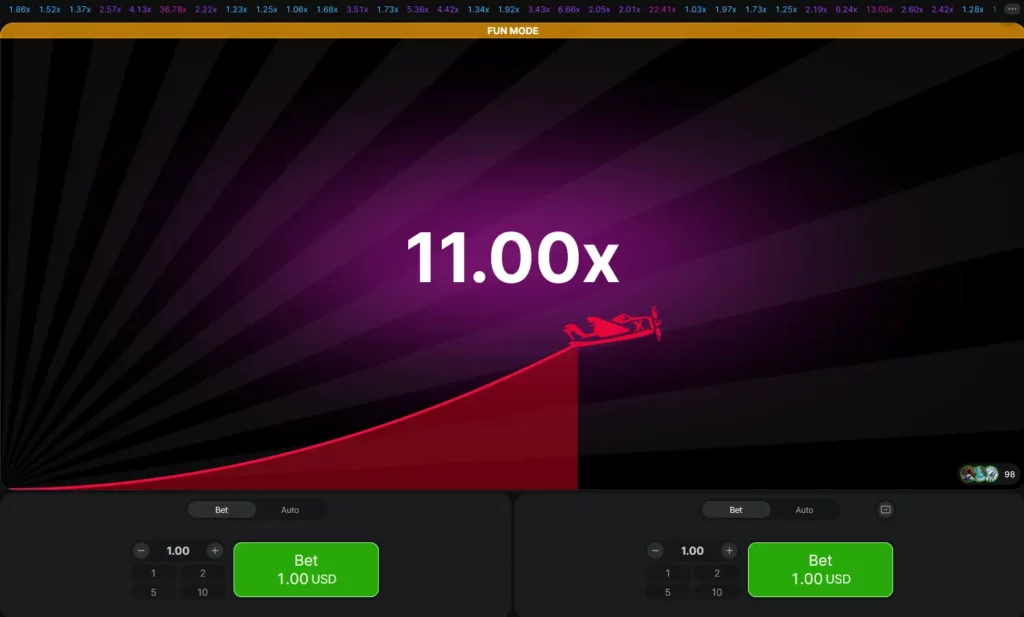
Aviator Big Coefficient
1xBet Bonuses for Aviator Players
1xBet offers a welcome package spread across four deposits that can extend the budget available for casino sessions, including crash games. The first deposit adds a 100% match up to R6,000, the second brings a 50% match up to R7,000, the third adds a 25% match up to R8,000, and the fourth deposit rounds off the package with another 25% match up to R9,000. The bonus comes with wagering conditions that need to be completed within a set time window, and the maximum stake while clearing the bonus is also capped. The free spins tied to this package apply to specific slots rather than Aviator, but the cash bonus balance can be used on this game once the relevant conditions have been met. It’s worth reviewing the full terms before opting into any offer.
Registration and Getting Started
Registration on 1xBet takes just a few minutes via email, a phone number with an SMS verification code, or direct authorisation through a social media account. Once the account is set up, it’s worth completing identity verification early to avoid any delays when requesting a withdrawal later on. After that, finding Aviator is straightforward — just head to the casino section and look under instant games or crash games.
Playing Aviator on Mobile
Aviator runs entirely on HTML5 technology, with no dedicated app or download required, and adapts smoothly to any screen size. The dual betting panels, auto cash-out, auto bet, and live chat all work exactly the same way on mobile as they do on desktop. The Android app or iOS app can also be installed for quicker access without going through the browser every time, with balance and history syncing automatically across devices.
Aviator Compared to Similar Crash Games
Aviator vs JetX. Both run on the same 97% RTP standard used across most mainstream crash games, and both use a rising multiplier with a single cash-out decision as the core mechanic. The real difference is dual betting: Aviator has offered two independent betting panels since launch, while JetX runs on a single active bet per round. Anyone who wants the variance-smoothing approach described in the strategy section above will find that specifically an Aviator feature, not a genre-wide standard.
Aviator vs Spaceman. Spaceman runs on the same underlying crash mechanic and a comparable 97% RTP, but distinguishes itself with a “Rain” bonus feature that periodically distributes small free bets to active players — something Aviator doesn’t include at all. For players who value that occasional extra bet outside their own stake, Spaceman adds a layer Aviator doesn’t try to replicate; for players who prefer a cleaner, single-mechanic game with dual-panel control instead, Aviator remains the more stripped-down option.
 Thabo Mthembu